No. Cats should not eat garlic. Garlic is toxic and can cause red blood cell damage and anemia.¹²

Garlic (an Allium food) can injure red blood cells and lead to hemolytic anemia. Cats are especially susceptible, and signs can be delayed for days.¹²

What to do if your cat ate garlic?

  • Remove the garlic or garlic-containing food and keep the packaging or ingredient list for your veterinarian.

  • If your cat ate garlic powder, seasoning mixes, garlic salt, or a large amount of garlic, contact your veterinarian immediately.

  • Do not try to treat at home or induce vomiting unless a veterinary professional instructs you to do so.

  • Watch for vomiting, diarrhea, drooling, weakness, fast breathing, pale gums, lethargy, or collapse, and seek urgent veterinary care if any appear.¹³

  • Even if your cat looks fine, call a veterinarian if you know or suspect garlic ingestion, because anemia signs can take days to show.¹

Danger Level: High Danger 4/5
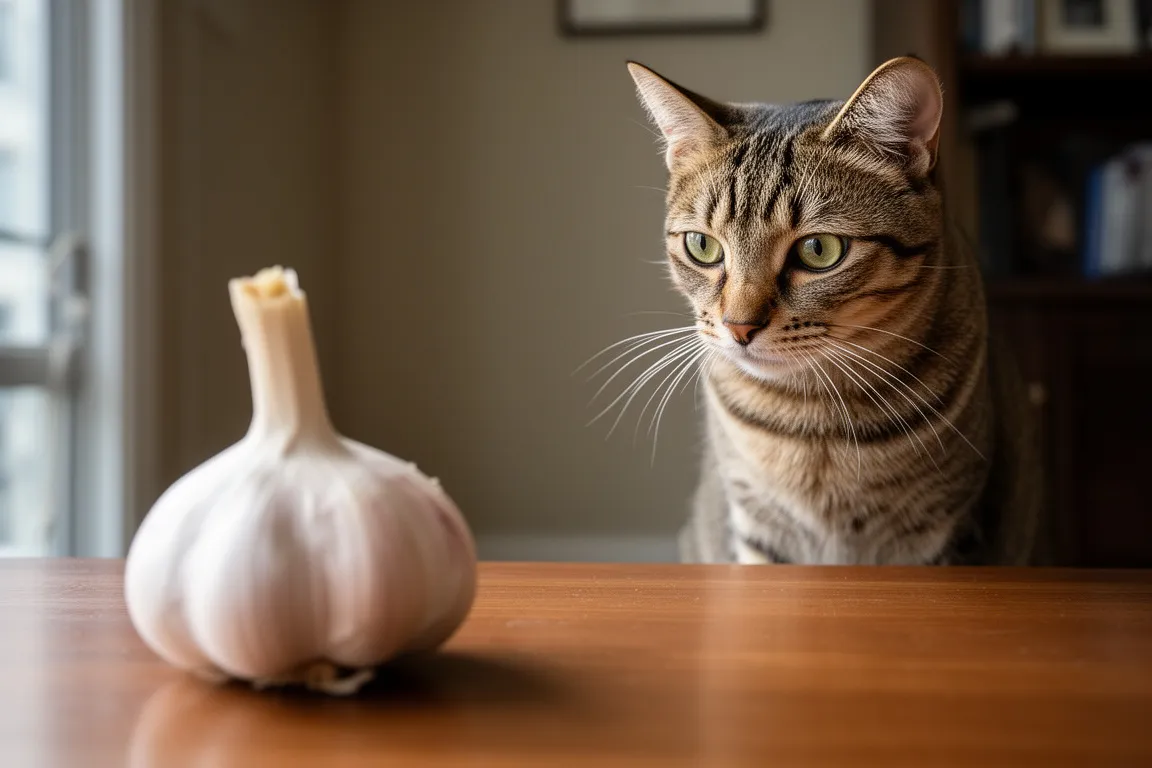
Cat looking at garlic

Can cats eat garlic? | Is garlic safe for cats?

Can cats eat garlic? Is garlic toxic to cats?

No. Garlic is toxic to cats. Garlic belongs to the Allium family, and Allium foods can damage a cat’s red blood cells and lead to anemia.¹² Garlic can cause problems whether it is raw, cooked, dehydrated, or powdered. Veterinary references note that concentrated forms like powders and flakes are commonly involved in toxicosis.¹ If your cat eats garlic or garlic-containing foods (especially garlic powder, garlic salt, seasoning mixes, or large amounts of cooked garlic), contact your veterinarian as soon as possible. Some effects can be delayed for days, so do not wait for symptoms to appear.¹


Why garlic is dangerous

Allium compounds can damage red blood cells, which may cause hemolytic anemia (including Heinz body anemia) and related problems.¹³ Cats are considered particularly susceptible compared with many other species.¹²


Garlic powder is a common high-risk source

Even small amounts of garlic powder or dehydrated garlic can represent a concentrated exposure compared with a small piece of fresh garlic. Veterinary toxicology guidance specifically highlights concentrated Allium forms as a frequent cause of toxicosis.¹


Symptoms may be delayed

Laboratory changes can begin within about 24 hours, but noticeable signs of anemia may take several days to appear.¹ That is why early veterinary advice is important, even if your cat seems normal right now.

Table of contents

  1. Is garlic safe for cats?
  2. What to do if your cat ate garlic
  3. Symptoms to watch for (timeline)
  4. How much is too much?
  5. FAQ
  6. References

Is garlic safe for cats?

Garlic is toxic to cats. Garlic is part of the Allium group (along with onions, chives, leeks, and scallions), and Allium ingestion can cause gastrointestinal irritation and red blood cell damage that may lead to anemia.²⁴

Veterinary toxicology references describe Allium toxicosis as causing Heinz body hemolytic anemia in cats and note that cats are the most susceptible species.¹

Garlic can be harmful in many forms, including raw, cooked, dehydrated flakes, and powders. Concentrated Allium products are commonly involved in toxicosis.¹

A key danger is timing. Although red blood cell changes can begin within 24 hours, clinical signs of anemia may take several days to appear.¹ This means a cat can look normal early on, even after a meaningful exposure.

What to do if your cat ate garlic

Symptoms to watch for (timeline)

How much is too much?

There is no recommended “safe” amount of garlic for cats. Because cats are especially susceptible, the safest guideline is to avoid garlic entirely, including small tastes and seasoned foods.¹²

Risk depends on dose and concentration. Veterinary sources emphasize that concentrated forms (powders, flakes, soup mixes) are commonly linked to toxicosis, so these exposures should be treated as high priority.¹

If your cat has underlying illness, is very young, or you suspect repeated exposures (for example, garlic-containing table scraps over time), treat the situation as more urgent and speak with your veterinarian.¹³

FAQ

References

  1. Merck Veterinary Manual. (n.d.). Garlic and onion (Allium spp) toxicosis in animals. Merck & Co., Inc. Retrieved February 7, 2026, from — https://www.merckvetmanual.com/toxicology/food-hazards/garlic-and-onion-allium-spp-toxicosis-in-animals
  2. American Society for the Prevention of Cruelty to Animals. (n.d.). People foods to avoid feeding your pets. ASPCA Animal Poison Control Center. Retrieved February 7, 2026, from — https://www.aspca.org/pet-care/aspca-poison-control/people-foods-avoid-feeding-your-pets
  3. VCA Animal Hospitals. (n.d.). Household hazards: Toxic hazards for cats. VCA Animal Hospitals. Retrieved February 7, 2026, from — https://vcahospitals.com/know-your-pet/household-hazards-toxic-hazards-for-cats
  4. American Society for the Prevention of Cruelty to Animals. (n.d.). Garlic. ASPCA Animal Poison Control Center: Toxic and non-toxic plants. Retrieved February 7, 2026, from — https://www.aspca.org/pet-care/aspca-poison-control/toxic-and-non-toxic-plants/garlic
  5. Cornell Feline Health Center. (n.d.). Beware holiday hazards. Cornell University College of Veterinary Medicine. Retrieved February 7, 2026, from — https://www.vet.cornell.edu/departments/cornell-feline-health-center/health-information/feline-health-topics/beware-holiday-hazards
  6. Kovalkovičová, N., Šutiaková, I., Pistl, J., & Šutiak, V. (2009). Some food toxic for pets. Interdisciplinary Toxicology, 2(3), 169–176. https://doi.org/10.2478/v10102-009-0018-6. Retrieved February 7, 2026, from — https://pmc.ncbi.nlm.nih.gov/articles/PMC2984110/

Related articles

Illustration of a cat with exclamation points in the background

DISCLAIMER

The information provided on Can Pets Eat It is for educational and informational purposes only and is not a substitute for professional veterinary advice, diagnosis, or treatment. Always seek the guidance of your veterinarian or another qualified animal health professional before offering any food to your pet. Never disregard or delay seeking professional advice because of something you have read on this website. We make no guarantees about the accuracy or completeness of the content, and we are not responsible for any actions taken based on this information. Please be reasonable, use common sense, and seek professional guidance whenever you have concerns about your pet.