No. Do not feed grapes or raisins to cats. Treat any ingestion as urgent and contact a veterinarian or pet poison resource.

Grapes and raisins are a well-known cause of kidney injury in dogs. In cats, true risk is uncertain and appears to be rare, but veterinary and poison-control sources note anecdotal reports and recommend avoiding them as a precaution.

What to do if your cat ate grapes?

  • Remove access to the grapes/raisins and estimate how much your cat may have eaten and when.

  • Save any packaging (trail mix, granola, baked goods) so you can share ingredients and amounts with a veterinary professional.³⁴

  • Call your veterinarian or a pet poison resource right away for guidance, even if your cat seems normal.¹²³

  • Monitor for vomiting, diarrhea, reduced appetite, lethargy, or unusual thirst/urination. Seek urgent veterinary care if any signs develop.¹³

  • Do not induce vomiting unless a veterinary professional instructs you to do so.

Danger Level: Moderate Hazard 3/5
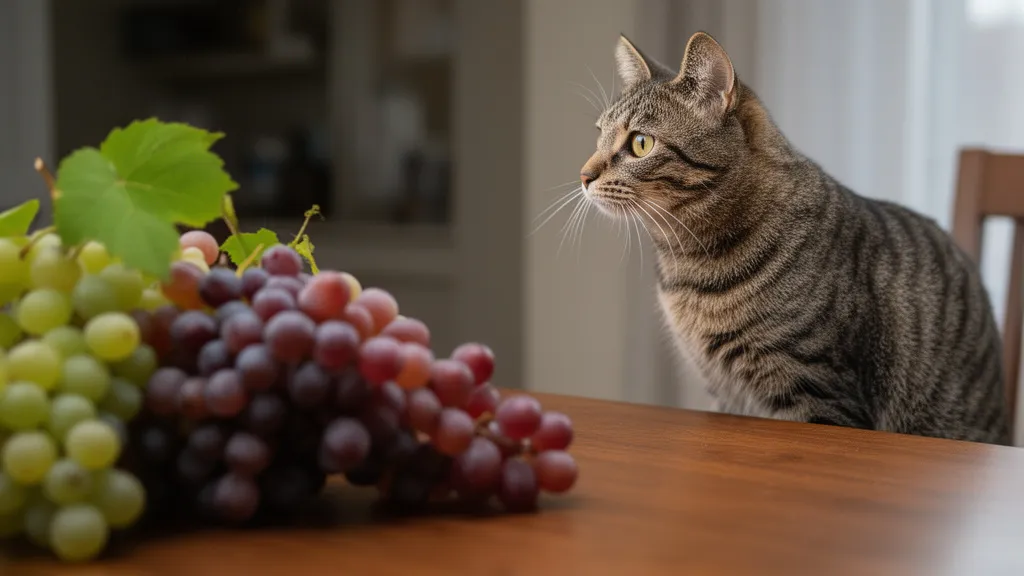
Cat looking at grapes

Can cats eat grapes? | Are grapes safe for cats?

Can cats eat grapes? Are grapes toxic to cats?

No. It is safest not to feed grapes or raisins to cats. Grapes and raisins are a well-known cause of acute kidney injury in dogs. In cats, true toxicity risk is less clear and appears to be rare, but veterinary and poison-control references note anecdotal reports and recommend avoiding grapes/raisins as a precaution.¹³ A veterinary reference also notes kidney failure has been reported in 1 cat after grape/raisin ingestion.² Because the outcome can be serious and there is no established “safe amount,” treat any ingestion as urgent and contact your veterinarian or a pet poison resource right away.¹²³


Why grapes are a concern

In dogs, grapes and raisins can cause acute kidney injury with unpredictable susceptibility.¹² The toxic component is still being studied. Veterinary references discuss tartaric acid and potassium bitartrate as suspected contributors to kidney injury in dogs.²⁵ For cats, reports are uncommon, but risk is uncertain—so the safest approach is prevention and prompt advice after exposure.¹³


Raisins, dried fruit, and trail mix are higher-risk exposures

Raisins, currants, and sultanas are dried, concentrated forms of grapes and are common in pantry foods like trail mix, granola, and baked goods.³⁴ Because dose-response is not predictable (especially in dogs) and cat risk is not fully known, avoid raisin-containing foods and call for guidance after any cat exposure.¹³


Time matters

Poison-control guidance emphasizes contacting a veterinary professional promptly after ingestion because early decontamination may be considered depending on timing and your cat’s condition.¹³⁵ In one study of confirmed Vitis fruit ingestions reported to a poisons center, cats most commonly developed gastrointestinal signs and no cats developed acute kidney injury—but the number of cats was small, so caution is still recommended.⁵

Table of contents

  1. Are grapes safe for cats?
  2. What to do if your cat ate grapes
  3. Symptoms to watch for (timeline)
  4. How much is too much?
  5. FAQ
  6. References

Are grapes safe for cats?

Cats should not be fed grapes or raisins. While kidney injury is best documented in dogs, veterinary and poison-control sources note that cats and ferrets may also be affected and recommend avoiding grapes/raisins as a precaution.¹³

A veterinary reference on food hazards states that kidney failure from grapes or raisins has been reported in some dogs and has been reported in 1 cat.² This supports taking exposures seriously in cats even though confirmed cat cases appear uncommon.

Because the mechanism is not fully settled and susceptibility can vary, there is no reliable “safe amount.” The safest approach is to avoid grapes and raisins entirely and contact a veterinarian if any are eaten.¹²³

Research is evolving. In a study of confirmed Vitis fruit ingestions reported to a poisons center, around 15% of dogs and cats developed clinical signs (mostly gastrointestinal), and no cats developed acute kidney injury in that dataset. However, the cat sample was small, so avoidance and prompt guidance remain recommended.⁵

What to do if your cat ate grapes

Symptoms to watch for (timeline)

How much is too much?

Because there is no established safe amount for cats and the potential outcome can be serious, the safest recommendation is to avoid grapes, raisins, currants, and sultanas entirely.¹²³

If exposure happens, do not rely on home remedies. Your veterinarian or a pet poison resource can advise whether monitoring at home is appropriate or whether decontamination and lab monitoring are recommended.¹³⁵

Keep higher-risk foods secured: trail mix, granola, raisin bread, cookies, and other baked goods with dried fruit.³⁴

FAQ

References

  1. VCA Animal Hospitals. (n.d.). Grape, raisin, and currant poisoning in dogs. VCA Animal Hospitals. Retrieved February 7, 2026, from — https://vcahospitals.com/know-your-pet/grape-raisin-and-currant-poisoning-in-dogs
  2. Merck Veterinary Manual. (n.d.). Food hazards. Merck & Co., Inc. Retrieved February 7, 2026, from — https://www.merckvetmanual.com/special-pet-topics/poisoning/food-hazards
  3. Pet Poison Helpline. (n.d.). Grapes. Pet Poison Helpline. Retrieved February 7, 2026, from — https://www.petpoisonhelpline.com/poison/grapes/
  4. American College of Veterinary Pharmacists. (2023, April 25). Grapes & raisins. Pet Poison Control. Retrieved February 7, 2026, from — https://vetmeds.org/pet-poison-control-list/grapes-raisins/
  5. Dijkman, M. A., & colleagues. (2022). Incidence of Vitis fruit‐induced clinical signs and acute kidney injury in dogs and cats. Journal of Small Animal Practice. Retrieved February 7, 2026, from — https://pmc.ncbi.nlm.nih.gov/articles/PMC9303671/

Related articles

Illustration of a cat with exclamation points in the background

DISCLAIMER

The information provided on Can Pets Eat It is for educational and informational purposes only and is not a substitute for professional veterinary advice, diagnosis, or treatment. Always seek the guidance of your veterinarian or another qualified animal health professional before offering any food to your pet. Never disregard or delay seeking professional advice because of something you have read on this website. We make no guarantees about the accuracy or completeness of the content, and we are not responsible for any actions taken based on this information. Please be reasonable, use common sense, and seek professional guidance whenever you have concerns about your pet.